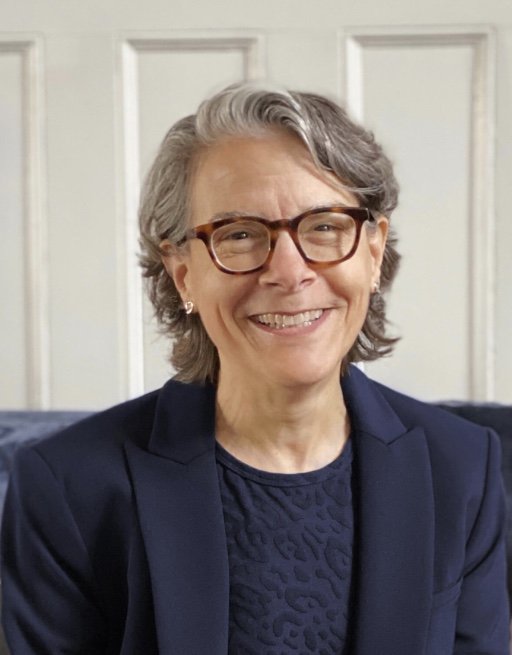
Michele Steckler helps people make things. She is a former stage manager, producer, and longtime Disney Theatrical leader whose work with Robert Wilson, Philip Glass and Julie Taymor led her to The Lion King. She’s also my neighbor, and I loved getting to hear the full story behind her career.
In this conversation, we talk about trusting your gut over the “safe” path, what it’s like to doubt yourself and say yes anyway, and what happens when the title you’ve carried for decades is no longer yours. We also talk about what Michele needs courage for right now.
Watch the Video
Take Aways
Trust that a “no” can redirect you to a “yes”
Choose a path that feels true over the one that looks smart
To break into a field you’re passionate about, consider and internship or working for free – it will open doors for you
More often than not, you know what’s best for you
Practice not knowing
Resources & Links
Learn more about Michele at https://www.michelesteckler.com/
Sponsor: Interabang Books, an independent bookstore in Dallas (interabangbooks.com)
Find us and subscribe on Youtube
Watch my TEDx talk, How I Redeemed 35 Years of Regret; you can also view it at triciaroseburt.com
Leave a comment and share it with your friends — it helps the story reach a broader audience Subscribe to, review, and spread the word about No Time to Be Timid
Get the free manifesto: triciaroseburt.com/manifesto
Transcript
Tricia Rose Burt: Welcome to No Time to Be Timid, where we help artists and entrepreneurs find the courage to make their mark now. You know all the voices in your head that tell you that you can't? We're the voice that tells you that you can. Our guest today is Michele Steckler, creative producer and, lucky me, my neighbor. Michele stage managed international productions by acclaimed director Robert Wilson, toured the globe with composer Philip Glass,
and after working with Julie Taymor on several productions, Michele was by her side playing a principal part in the creation and rollout of The Lion King on Broadway and around the world. I asked Michele before the show which manifesto principles rang truest for her. And she said, "The riskiest thing you can do is play it safe," my personal favorite. "There is more than one right way in life.” “Don't expect a linear path." "Constraints are opportunities," and "there is courage in community." When you hear Michele's story, you'll see every one of those in action.
Hello, Michele. We're so glad to have you on the show.
Michele Steckler: Thank you. I'm so glad to be here.
Tricia Rose Burt: I love the fact that you're really just right up the street.
Michele Steckler: No, it's great. But technology still, you can't beat it.
Tricia Rose Burt: No, no, you can't. Okay. So I've had the best time researching you, and you have had a rich, full life, my friend. It has really been fun to just get to know what you've done and research everything that you've done. But I wanna ask you a question. This is the loveliest moment before we get into all of your professional work that you've done. I listened to a talk that you gave in Jaffrey last summer, I guess. And I want you to tell the story again about your stage debut because I love that. I love it so much. Talk about your stage debut.
Michele Steckler: My stage debut was in 1968. That summer, my older sister Nikki was taking a summer school theater program. And I was not allowed to join because I was five years old and you had to be six or older. And I was going to turn six in November, and this was July. And it just seemed terribly unfair to me that I was not allowed to be part of it. So I pleaded with my mother to let me visit. Just bring me and let me see if the teacher will let me visit, which that happened. And then I was my very best all day. And at the end of the day I went at it with the teacher and tried to convince her that I really felt like I was six and I knew I could be part of this. And she let me do it.
And there it was in a school gymnasium, little Michele playing Molly Malone in, I don't know, it was like some kind of variety show of I don't know what. It wasn't like we were doing a play, but I just remember the gymnasium and the rows of metal chairs, and there I got to be Molly Malone. There was a recording of the, you know, the Irish tune, and she wheeled her wheelbarrow. And I wheeled a wheelbarrow that was as big as I was down the center aisle, serious.
I mean, I might as well have been in a Bob Wilson show.
Tricia Rose Burt: You were in character.
Michele Steckler: And I was so in character. It was formative. I fell in love completely.
Tricia Rose Burt: I can tell you what, I was Mother Nature in Baskets or Bonnets in the second grade. And I mean, from that moment I'm like, this feels pretty good. This feels pretty good. So I can see you as little Molly Malone. That's fantastic.
Okay, the next one I want you to tell, because there's a great narrative arc in this conversation I want to have with you, is the first time you saw a live performance, which was Fiddler on the Roof. Was that it?
Michele Steckler: Yes, yes.
Tricia Rose Burt: Talk about what it felt like to see that for the first time.
Michele Steckler: Yeah, so this was in Windham, Connecticut, tiny, tiny town, much like Hancock, where we both live now. And my parents, who both loved the theater, had a season subscription for the summer to the Nutmeg Summer Playhouse, which was at the University of Connecticut in Storrs. So I think it was two summers after my big debut. We went to the first show of the season, which was Fiddler on the Roof. And I just remember piling into the station wagon. I remember parking in a lot that was next to a field of cows, 'cause you know, it's rural Connecticut. I remember getting my ticket and I just wanted to hold on to that ticket so badly. You know, it was back in the day when you had that nice, like, oak tag rectangle, long rectangle.
And then I just remember sitting in this theater with the people and the buzz of the crowd around me and holding my program, which was heaven. I just was looking at the photographs and the scene list and the songs, and you know, my feet didn't even hit the floor. And when the curtain went up, there was a silhouette of a man on a roof playing a violin, the fiddle.
And then the lights came up and I realized it was a real man. I mean, I don't know what I thought at first. I was just so captivated. And I remember how quiet it was during certain moments. And I remember just the bursts of applause at the end of big musical numbers. And that to me equaled what it felt like to be on stage, to be in the audience and feeling that sense of being in the dark. I remember that from the Molly Malone as well, that being in the dark and this thing unfolding. And then of course my sister and I, I mean, my parents bought the record and we used to sing those songs to each other. You know, "Matchmaker," and "Do You Love Me?" "Do I what?" You know, we'd do this back and forth. We learned the whole thing inside and out.
Tricia Rose Burt: I could do it with you right now. I'm not sure that's really what the course of the show should be. But I could do the call and response as well. Probably not as well as you. I know, yeah, absolutely. And I mean, I can remember the first Broadway show I ever saw, actually on Broadway. I was in the ninth grade and friends of mine took me to New York for the first time and I was like, "These are my people." I mean, I had come from Tampa to New York.
And I saw Candide and Goodtime Charley with Joel Grey. And I was like, alrighty then, sign me up. You know, just that whole idea of watching this live experience unfold is really, really something. So tell me though, you wanted to be an actor and you were on the stage in various performances all through high school, all through college. When was the moment when you're like, no, wait a second, backstage is really what does it for me?
Michele Steckler: Okay, two very clear moments. So the moment when I realized acting was not what I would pursue. I was a sophomore in college taking an acting class. I'd been assigned a scene from A Streetcar Named Desire. I was to play Stella opposite a classmate who was playing Blanche. And it was the morning after the big row with Stanley where he's drunk and he breaks things and the kitchen's a mess and then he, you know, takes her off for passionate lovemaking.
So it's the next morning and the scene begins with Stella sweeping up the kitchen. And we were in the theater for this. We didn't always do our scene work in the theater, but I remember that. And all of my classmates and the teacher were sitting in the audience. I'm on stage. We do the scene and then we come to the front of the stage to get our notes. And the acting teacher had quite a critique for me. And the gist of it was that she said I looked like a maid sweeping up as opposed to a woman who'd, you know, just had this passionate night with her handsome husband. She was really pressing on that I was not at all sexy. And it was so embarrassing. And I had been playing roles like Snoopy in You're a Good Man, Charlie Brown.
Tricia Rose Burt: Yeah.
Michele Steckler: And doing things that were fun for me. And so I just it wasn't that I was so mortified and embarrassed that I decided I could never do it, but a light went off, because she went on to say that I really needed to stretch myself and work more on roles that were perhaps outside of my comfort zone. And I just remember thinking, do I really want to do that? And then I think I went to audition for the next show and I sat there in the hallway looking at my classmates who were so passionate and driven and dedicated and I realized I wanted it to be fun and it suddenly didn't feel like it was fun anymore.
And then the next thing that happened is that someone asked me to stage manage a little student-directed show. And I thought, okay, why not? I'd been taking classes. I was a theater major. I'd been taking classes on, you know, set design and behind-the-scenes stuff. And that was my God ray moment. It was like the God rays came down from heaven and shone on me and said, "This is what you're meant to do, Michele." And then I started adding it all up. I'd been a leader, you know, class leader, student body leader in high school. I loved complexity and listening to people. And stage managing was everything that I did naturally that felt like it was fun. It was so clear. So from that moment on I knew I wanted to be a stage manager.
Tricia Rose Burt: You know, it's so funny how often, I mean, so many of our guests, and it's happened to me, you get a no, and sometimes that no really hurts. And it's just a redirection. It's like, no, you're supposed to go in this direction, and then you find the yes, and it's like, thank goodness that no happened because now I can really step into, you know, who I'm supposed to be.
I love this – when you graduated from University of Vermont, there was a pivotal moment for you when you had one professor say, go to Yale and get your MFA, and one professor say, just get an internship, work for free, and you'll get a paycheck soon enough. And you went the route of just get an internship, work for free, and it'll happen. Tell me why you made that choice, because it seems like going to get your MFA and getting that credential from Yale or whatever would be a safe, secure route. And you went, kind of, screw it, let me just jump in. So tell me a little bit about what made that decision for you.
Michele Steckler: Yeah. Well, so the professor who said that I needed to get my MFA was the acting professor who had been so cruel to me.
Tricia Rose Burt: No way. No way. That's very interesting.
Michele Steckler: I had an immediate sense, a couple things. One was I thought, I'll never get into Yale. I thought, I can't bear another three years of being in the classroom. I liked school and learning, but I was not a great student. I had to work really hard to memorize things and I was an experiential learner. I had to do it. There were no classes in stage management at UVM.
I learned everything I learned about stage managing by doing it and working with professors who were designers and whatnot. So I intuitively sensed that that was not the right path for me. Even if I thought I could get into Yale, I think I just knew that I needed to be in it as opposed to sitting in a classroom. And I loved the idea of an internship. I also thought that that process would be sort of fun. Like, well, who has internships and where might I go? And then that was a whole 'nother part of it, which was I applied for two internships, one at the Folger Shakespeare Theater in Washington, DC, and the other at the American Repertory Theater, the ART, in Cambridge, Massachusetts. I can't remember anymore why those were the two, but I was kind of called in to interview. I took the train to Washington, DC. I spent an overnight. I wore a skirt. I was all ready for my interview. And I spent an entire day with the stage management team and in and out of rehearsals, and they asked me to be on book, which means you follow the script. And if an actor, while they're rehearsing, needs a line, they call for line and you give it to them. There's a real art to that. I was very good at being on book 'cause I could focus, and I spent half a day on book with Shakespeare.
And people were perfectly lovely. But when I left I was on the train coming home and I thought, I don't think I wanna do that. I'd have Shakespeare twenty-four seven and having to be on book most of the time if I'm not making photocopies or getting coffee and whatnot. And then I went to the ART for my interview. I was living in Providence, Rhode Island at the time, so it was a quick trip. Actually, yeah, I was at UVM but my family was in Providence and I was home at the time when the interview was scheduled. Anyway, I met the production stage manager, who was super easygoing, and we just chatted and he showed me around the theater and I just, it's that thing of, I felt a sense of home there. I can't exactly say why, but the space was beautiful and intimate and we walked through the scene shop. And here's the other thing.
The Folger internship was a nine-month commitment. No pay, no stipend, nothing. I knew nobody in Washington, DC. The ART internship was just on one show. It was six weeks. Okay. And my older sister, my beloved sister Nikki, was at Harvard at the time and had an apartment that just happened to have an extra room that was literally a block and a half from the ART.
Tricia Rose Burt: Good Lord. Well, that's a no-brainer.
Michele Steckler: It was a no-brainer, but what I have only realized in hindsight is that my entire career unfolded because I went to the ART. Because of who I worked with, because it was on a Robert Wilson show. And I didn't know who Robert Wilson was, you know, when I started, but he's a giant in the avant-garde world. But what I've shared oftentimes with students when I share this story is that it wasn't even a safe path necessarily, sort of the go getting the MFA or whatever someone might have thought about the Folger. It was that I listened to what felt accurate for me as opposed to what other people thought. And the big thing is that I went for a gut feeling, but also ease and comfort and practical logistics in terms of having a place to stay with my sister. And I was just out of college. I was with my family. It was comfortable in that way. It wasn't a big stretch of going far afield. And look how it turned out. So the notion of not paying attention to, okay, where might I meet people who will help me network or further my career, what's gonna look good on my resume. None of that was anywhere on my radar.
Tricia Rose Burt: Yeah. And what I really love is the ability to say no to an authority figure at that time who thought they knew what was best for you, and you knew what was best for you. I mean, listening to yourself, it's like, nope, this is where I should go. And so that's a very brave thing to do. And I think often, I mean, I've done this before in my life where it's been like, well, they know better. I mean, they're in this position or they've been in the industry longer or this or that, and sort of overridden what I was thinking. And it never turned out well, you know, if I override what feels right. Yeah. And so that's why you're just a proof of the success of that.
But is work for free to get your foot in the door still good advice? Does that still work? Would you still recommend that?
Michele Steckler: Absolutely. I do believe in that, because if you really want to do something, and again, maybe you can't do it for nine months or a year, but for six weeks, which turned into a paid, by the time we went into technical rehearsals, they had hired me to be the ASM, the assistant stage manager on deck, and I was getting a paycheck. And when the show closed, I worked in the scene shop. So for me, and I think this I'm not special. It's anybody who is passionate and has some skill and is dedicated and ready to really work hard. You work for free and someone is gonna notice that and say, "We want you to stay," or "We wanna help you find something," or "We don't have something now, but we will soon."
Tricia Rose Burt: Yeah, yeah. No, that's great. That's great. Okay. It did kick off an incredible career for you that led you traveling with Robert Wilson, with Philip Glass, all over everywhere. How did you meet Julie Taymor?
Michele Steckler: So I met Julie Taymor. See, this is another fun thing about how we can't plan these things in life. And you have so many wonderful principles in your manifesto, almost all of which I embrace wholeheartedly, but that notion of the path not being linear. Yeah. So in my stage managing years, I was offered a job as the production stage manager for a season at Trinity Repertory Company in Providence, Rhode Island. And it was the season that Anne Bogart, another extraordinary avant-garde, I would say, director, who I had worked with years earlier, she was brought in to Trinity Rep as a new artistic director. And she asked me to join her as the production stage manager, which I did. And I was really excited to put down roots and be in a place that was familiar. I'd spent my high school years in Providence. And I thought I would be there for five, ten years. I mean, that's what you do in regional theater. Well, it was a very avant-garde season and it was Anne's first and last as the artistic director, which meant it was my first and last because I was only there to work with Anne. I wasn't gonna stick around. So Anne left and started SITI Company, which became a huge force in the theater world, and she also went on to teach at Columbia. But I met Julie Taymor because of that. I met Julie because I was leaving Trinity Rep without anything on the horizon. And I got a call from Music-Theatre Group, the producer who had introduced me to Anne, saying, "Hey, we need a stage manager for Julie Taymor's Juan Darién. Are you interested? We heard that you and Anne are leaving Trinity." And so I said, "Sure." And I'd heard of Julie, but it was not a great beginning for me and Julie.
Tricia Rose Burt: Are you allowed to talk about it?
Michele Steckler: No, I can talk about it, sure. Here's the thing. Juan Darién, an extraordinary piece that she and her husband, Elliot Goldenthal, created, a carnival mass, masks, puppets, music. And it had run in New York City. It had two separate runs off Broadway, very successful. And it had been picked up by some international festivals. And so the first two stage managers were no longer available or interested, I can't remember. But they needed a new stage manager. So the piece had been done already. And I was brought on to do the Edinburgh Festival, the Lille Festival in France, a couple of other festivals, and then a run in San Francisco. So I was the new kid. Most of the original cast and Julie knew the show. I had a script with the cues in it and a very poor-quality VHS tape that had been, you know, a bootleg recording because you weren't allowed to record things because of Equity rules. And one week of putting the show together in New York City, and then we were in Edinburgh, literally opening the festival in the big venue that had a raked stage. And to say it was a miracle that we got through the show without injury or incident is not an understatement. But I discovered when I climbed up to where I was to call the show, which was the follow-spot booth, high above the nosebleed balcony, which was insanely high. And I got up there right before it's time to start the show. And I realized I did not have a completely unobstructed view of the stage. There were grid pipes that hung down and I couldn't see certain things. And it was, from my perspective,both a miracle and a disaster.
I called light cues and lights came up that hadn't been focused yet, that were pointing into the audience. And the lighting designer, who was sitting next to me, was working with the board operator telling them what dimmers to bring down. I mean, it was really crazy. And the final cue of the show, I blew. The final cue of the show was a blackout and there was a Bunraku puppet of a skeleton who extended his finger and a dragonfly, so Julie Taymor, just in a beam of light, the dragonfly lands on the finger, and the actor who's attached to this Bunraku puppet says “ah”, and then there's another beat and then the blackout. So it's a sequence of events. And I could not see if the dragonfly had landed on the finger. And I'm looking and I'm down and I'm up and I'm trying to see. And then I'm listening for the “ah”, and I'm thinking, did he say it? And it seems like an eternity. And so finally I just called a blackout cue. And when I made my way backstage after the show, the first person who met me in the dressing room area was this particular actor, who, other than that moment, was a lovely guy. But he lit into me. "You called the cue too soon. I didn't say the “ah” yet.'" You were getting, and all I could think was, "Are you effing kidding me?"
And then the next person in my face was Julie, who didn't say anything about that, but had a long, long list of what went wrong and this and that with the crew and we needed to rehearse the next day. And I did not, my recollection is that I didn't say a word. I listened, I took it all in and I walked away and I went into a stairwell and I completely broke down. And I was in that stairwell, I kid you not, for several hours. And my beloved friend and assistant stage manager who ran the deck, she was so brilliant, Beth, sat with me and I remember thinking, this is what a nervous breakdown feels like. Like I couldn't imagine coming back the next day. I said, "Of course I'm gonna come back the next day, but I'll do the next stop, but then I'm not gonna do the rest of the tour, I'm done," and, you know.
Tricia Rose Burt: And so maybe that exactly didn't go that way.
Michele Steckler: I finished the tour and I kept saying yes and yes and yes to Julie because she's extraordinary, and yeah.
Tricia Rose Burt: Because it was Julie Taymor. So you get over the nervous breakdown, you end up doing the tour, you do several things with Julie, and then you end up on The Lion King with her, which was obviously a major experience for you. So this is where I know that when she asked you to be the assistant director, you were in trepidation. You didn't know at first whether or not you wanted to do that. Tell me why you didn't want to leap into that. What was the hesitation there?
Michele Steckler: It was so, there were different layers to it that I had to find my way through. Part of it was exhaustion and feeling a little bit on the edge of some burnout and wondering if I wanted to dive into another big show. Part of it was intimidation around Broadway and Disney. I'd never worked on Broadway. I had never aspired to work on Broadway. I kind of loved the whole avant-garde world where we never thought about reviews. We just did these big epic cool pieces all over the world and sometimes in the States. But I started having real doubt and wondering, what would I do? What is the role of assistant director on Broadway? I just had this image that it would be different. And what got me…
Tricia Rose Burt: Different how?
Michele Steckler: Well, I didn't even know. I just thought these people are better or in a different league or…
Tricia Rose Burt:And who were the people of the cast? Everybody around you? 'Cause you knew Julie and you'd work with Julie.
Michele Steckler: I knew Julie, but it was such a foreign world. I didn't know. But I had struggled over the years with this friend called doubt, and sort of a funny inner voice of "I'm not good enough" or "I don't have enough experience." And some of it was based in all of those earlier years where, I mean, leaving the ART, my first thing after interning was Robert Wilson asked me to stage manage a European tour of his piece called The Knee Plays. And I went all over Europe as a twenty-three-year-old woman in charge of this huge Bob Wilson show. And I was out of my league. I was just trying to make it work every single day. And I did it, but it was painful. I was constantly feeling like I was stretching beyond the beyond. So even though I had never failed per se, I had been in many painful circumstances where growing was just hard. And so I think thinking about the Broadway thing, as opposed to saying yes in the way that I had in the past, I took my time and I thought, I don't know if I can do this. And I went to a dear friend, another stage manager who I'd met at the ART, Abby, and said, "What am I gonna do? Julie wants me to do The Lion King." And of course, Abby said, "What's the problem?" And I said, "I don't know what I'll do in the role." And she gave it to me so clearly. She said, "Michele, you're gonna listen and tell people what's happening. That's what you do.”
And it was such a pivotal moment because it was someone speaking a truth to me that I knew she was right. I'd never thought about that though, that what I do instinctually and what, if you will, had been the secret of my success was that's what I'm gonna do. And the other thing that made me say yes was that Julie, as ever, seduced me. I mean, she had me up in her studio. She was like, "Come, I wanna show you the sketches and what I'm sculpting." She sculpted all of the masks and puppets and she said, "I want to show you one by one. I want you to hear this music and describe it to you." And you get into a room with Julie like that and it's intoxicating. And so I said yes, thankfully.
Tricia Rose Burt: Yes, thankfully. I do understand what it's like to put yourself in a situation where you kind of never relax because you're always learning and you're always on. And there's a vigilance that happens nonstop. And so I can appreciate your desire to go, can I just kind of chill for a little bit instead of jumping into this? But I'm so glad you jumped into it because what an experience, you know. And was it that different? Because oftentimes, I've talked with several of my guests where they have a skill set that's transferable. And you had this incredible skill set that you had been using in one context. You did operas. I mean, all the things that you were doing, it was pretty incredible that it just went straight over to Broadway. Like it was just a different context. Did you have the did you have the bumps you thought you would have or was it fairly seamless going into it as far as your skill sets?
Michele Steckler: It was completely seamless. The minute I was in the rehearsal room, I was in my element. And so there were a few things there. I realized right away that I was among a vast many others who had also never worked on Broadway. Most of the cast had never worked on Broadway. Singers, dancers, principal actors. The design team, only one, actually only one person from the original creative team had worked on Broadway before, and that was Don Holder, the lighting designer. Everyone else was new to Broadway, including the producers, Tom Schumacher and Peter Schneider, who were running Disney Animation and were also running Disney Theatrical. But they were theater guys. That's an incredible story of how they ended up at animation, but they were theater guys. So they if anything, it made The Lion King The Lion King because we all had this sort of beginner's mind. And we weren't trying to make a Broadway show. We were all working in service of Julie's vision and telling this story that everyone knew the story would work because of the animated film. But would this wild, interesting, double-event puppets-and-actors vision translate? You know, would the audience get it? So I had a ball. I mean, it was challenging. It was like running a five-ring circus. But I found my groove right away. And thankfully, the production stage manager, Jeff Lee, was a seasoned Broadway stage manager. Okay. That Julie and the producers were smart enough to have someone in that role
who knew that world inside and out. So in many ways, he, and then the crew, once we were in the theater, they carried us. They taught us what we might have been lacking in terms of Broadway experience.
[Sponsor message]
Tricia Rose Burt: We'll get back to the second half of our conversation in a moment, but right now I want to tell you about our sponsor, Interabang Books, a Dallas-based independent bookstore, which was named one of the country's top five bookstores by Publishers Weekly. They have a fabulous curated online collection, and it's just as easy to shop with them as it is with Amazon. Who doesn't want to support an independent bookstore? Please show them some love and check them out at interabangbooks.com. That's Interabang, I-N-T-E-R-A-B-A-N-G books.com.
[Interview continues]
Tricia Rose Burt: I've heard you tell the great story of, I think it was the choreographer? Who are the two people that went, they'd never seen a Broadway show and they went to see a Broadway show and left in the middle of it going, "Wait, this isn't gonna be what The Lion King is going to be." I love that story.
Michele Steckler: Lebo M, one of the composers. Elton John wrote five songs from the original film, and then a few new ones that he wrote with Tim Rice, the lyricist. And then Lebo M, this extraordinary South African composer, collaborating with Mark Mancina, who's a music producer and had done the animated film with Lebo. So Lebo and Mark were thinking, "We gotta go see some Broadway musicals because we don't know what we're doing." And so they went to see their first of what they thought would be several shows and they left at intermission because they realized it was so not like anything they could ever imagine doing. And through that experience they realized, we just need to do our thing.
Tricia Rose Burt: Which is just so extraordinary, to say we're not going to fit ourselves in the box that is Broadway and create something that is brand new. And it's, you know, number two in the manifesto, there's no one right way to do something. And fortunately they said, "We're not gonna do it that way. We're gonna create this whole new world and environment."
What was the most difficult aspect of the production of The Lion King that audience members would never consider?
Michele Steckler: Mm. That's a great question. I think overall the complexity of the masks and puppets added so much that is not present in your average musical. Even something that's big and has a huge cast of fifty-two people and a big crew backstage, all of that. The addition of those elements, what it required in creating it in terms of departments connecting and coordinating, and I mean masks and puppets that didn't even exist as a department. There was the tussle of, okay, if it's something they carry, it's a prop, and if it's something they wear on their head or their body, it's considered a costume.
And costume departments, they didn't have any experience with how to handle and maintain these masks and puppets. So a whole 'nother department had to be created. But in terms of creating the show, that just adds a lot of time to what is already a very complex process. And I think the other element that one might not think of in the audience are the transitions.Transitions are the glue that hold a show together.
Tricia Rose Burt: Tell us what you mean by transition, Michele.
Michele Steckler: So a transition is what happens between scenes or between musical numbers. So for example, "Circle of Life," the opening number. You have "Circle of Life" and the final notes, and there's a blackout, and the curtain comes in, and then a transition is happening because Pride Rock needs to disappear below the stage. All of those ensemble cast members need to leave the stage and get out of their animals. All of these things need to happen to make space for the next scene. So a director plans for transitions. And in this case, Julie planned on a drop to come in so that all of that, all the disappearing of scenery and people, could happen without the audience seeing it. But you need to fill that time with something.
So the drop comes in, Scar walks out on stage and stands still in a pose. And almost before we even see Scar, what we see is a shadow puppet of a tiny little mouse. It's the smallest puppet in the show, making its way across the stage from behind the drop. So shadow puppets work, you put a cutout of something right up against a piece of canvas or plastic scrim fabric, and a light from behind means that the audience sees the silhouette. So this little mouse is coming along, coming along, coming along, and gets right next to Scar, and Scar is watching the mouse, because that's lunch, and he takes his walking stick and hits it and kills and captures the mouse. And thus the next scene begins with Scar holding up the mouse and Zazu comes in.
So that was a long explanation of a transition, but there are other transitions. The biggest, most complex transition was to go into the Stampede scene because all kinds of scenery needed to be set up. The scrollers and rollers and wildebeests and platforms and canyon walls. And there's stories about what happened with that that I won't take up time with right now. But planning for those transitions is crucial. And even though Julie brilliantly planned for every transition, the one into the Stampede did not work in the time allotted. And we had to, we had basically during previews out of town in Minneapolis, a new scene had to be written, to be a little downstage of a curtain crossover scene to cover the amount of time it would take to move into the Stampede.
Tricia Rose Burt: Yeah. With a lot of moving parts there.
Michele Steckler: A lot of it. I mean, I think your original question, very simple, about what the audience might not know. I suppose that's it. They wouldn't know how complex what's happening behind the scenes is. It's a whole 'nother show.
Tricia Rose Burt: So your first experience watching Fiddler on the Roof when you're a little girl, you were filled with, you know, all kinds of awe. How did that compare to the first time you're in the audience with Julie Taymor watching The Lion King come to life after how many, how long had you been working on the show?
Michele Steckler: So we had five weeks of rehearsals in a studio, or a series of studios, in New York City, and then three weeks of technical rehearsals on stage in Minneapolis. And then it was time for our first preview. And I remember that about as vividly as I remember being a little kid. And I remember getting our tickets from the company manager's office backstage. We had production seats, but we still needed a ticket to show the usher. And we went from backstage up into the back of the house, down, and sat. And I remember sitting there with my, not with the program, but with my notebook and pen at the ready to take notes for Julie, and just that buzz of the crowd and the curtain rising. And I don't know if you've seen The Lion King, but the very first image is of Rafiki at the edge of the stage, sort of as iconic, I think, as seeing a fiddler on a roof.
Tricia Rose Burt: Yes.
Michele Steckler: That Rafiki just launches into her "Nants ingonyama" and the clouds begin to lift into the sunrise. And it was a full body, that mixture. What was different was the mixture of nerves and excitement and anticipation. As a kid, it was just excitement and anticipation. I didn't know enough then to be nervous for anybody, but boy.
Tricia Rose Burt: You had to have a sense of so much pride. You know, and also a narrative arc from going from this little girl to now this grown woman who's helped bring this thing to Broadway, the person who was sobbing in the stairwell because you missed the cue with the dragonfly, the professor who was saying you're not sexy enough to be Stella. I mean, there's so much redemption there and so much accomplishment there that happened because you persevered. I mean, you just kept persevering. I also remember when you were saying that you were traveling all over Europe and you were in Germany and they didn't want to have a woman stage manager on the stage. So how much, it's just such a satisfying, particularly as a woman in the arts, journey for you to end up in that space and bringing something that powerful, that people, how many years has it been on Broadway now? Twenty-seven? Some crazy amount?
Michele Steckler: Twenty-nine years on Friday, November thirteenth.
Tricia Rose Burt: Really something. That's really something.
Michele Steckler: So it's really fun to hear you describe the arc as you see it, as you've heard it, all of which is true. But I have to say, whether it was that first preview in Minneapolis or when we opened on Broadway, I wasn't thinking about any of that. Honestly, I'm not just being falsely modest.
Tricia Rose Burt: Well, I'm sure you weren't.
Michele Steckler: I had no sense of pride. I don't know quite how to describe it. It was certainly at that first preview, we didn't know what we had yet. We'd never seen it run through. And we didn't know until we had an audience responding to the show and specifically responding to "Circle of Life" and the animals coming in. I mean, we'd just seen it in an empty theater. We were too close. We didn't know. But in the company, it's that magic of theater. It's what I felt as a little kid. In the company of whatever it was, 1,700, 1,500 other people, and seeing and feeling and hearing their reactions, I did feel a sense of awe and astonishment. Yeah. Almost as if I, like the audience, which I was in a way, was seeing it for the very first time. So it was more that sort of sensation than, I was too in it to have any sense of having been part of it, if that makes any sense?
Tricia Rose Burt: No, it totally does. You're way too close to it. You're way too close to it. But again, I can see, having this conversation with you, going, this is such an incredible arc of where you came from and where you ended up. It's really very inspiring. So much perseverance, so much dedication to the craft, so much, you know, joy and working and collaborating with people in the theater. I mean, you just follow what you're called to do.
So you ended up working after The Lion King for Disney for fifteen years, right? And what were you doing with them for those fifteen years?
Michele Steckler: So what happened actually, even before The Lion King opened, is that Tom Schumacher, one of the producers, took me to dinner and he said, "You know, you're really a producer at heart. And you've been, like, the line producer on the show so far. And we would like you to stay with the show and become an associate producer and really take care of Julie's vision, figure out how this is gonna run eight times a week on Broadway and help us roll it out around the world," because by that time partners from Japan had come to see the show and wanted to open it the next year, which happened. And Tom and Peter already knew that a production would want to be brought to the West End. And by the way, both of those productions are also still running.
Japan in December will hit twenty-eight years. And last month in London the show hit twenty-seven years. I mean, it's just astonishing. And again, we had no sense of any of that. But Tom saying this, I thought that was a moment when I might have, shoulda, woulda, coulda had some hesitation. But every part of me just said,
Tricia Rose Burt: Yeah.
Michele Steckler: yeah, that feels right. I think I'd like to stay with the show. And yeah, I guess I am sort of a producer. And so I said yes, and only after saying yes was I hit in the face, literally the day after we opened on Broadway, when I walked into the office and realized I had an assistant who wanted to know how I wanted my phone to be answered. And I mean, it was talk about being stretched in a way that made working on The Knee Plays in Europe look like kindergarten. I mean, it was rough. But those next fourteen years, I went from being the associate producer on Lion Kingand opening productions around the world to then starting to work on new productions in the pipeline, The Little Mermaid, Tarzan, eventually was able to work on Mary Poppins.
And so I worked on development and all that came with that, from readings and workshops and doing prototypes. I mean, that was really, really fun stuff for me, to be constantly working on new things and continuing oversight of Lion King because I had such deep history. And so I was always around at sort of final casting and previews and openings of new productions around the world.
Tricia Rose Burt: So when you decided to leave Disney Theatrical Group nearly fifteen years later to start your own company, what did walking away from that security feel like?
Michele Steckler: Initially it felt like freedom, like a relief. I loved it until it wasn't the right thing anymore. And there's so much complexity and several years of processing that led to my realizing it was time to leave, and that there was a sense of completion, but also a sense of there's something more for me to do beyond traditional theater in terms of supporting people. And so initially it felt great. It was exciting. There was no fear. I had no specific plan, and that also felt good. I was really trusting what was beginning to unfold quietly inside of me. And then I was hit with a big, harsh realization of kind of an identity crisis for the first time in my life that I did not anticipate. I was diving into my next chapter of facilitating. I was working with some wonderful facilitators with a program called Coming Into Your Own as part of a conference. It was a leadership conference. And I ran a little session with a colleague at the very end of the conference. And it was during that session where I was, in theory, co-facilitating something where I felt like, I don't know what I'm doing. It was yet again, I don't know, this is a whole new world. And when it was over and my co-facilitator, who I was just getting to know, started to thank me, and I thought, "What are you thanking me for?" And I looked at her and I said, "I didn't do anything."
And she said, "My gosh, you held the space," and, you know, used all this terminology that I didn't even really know what that meant. And she said, "I mean, you're, you know, you're this big Broadway producer, and it was such an honor to have you." And I just looked at her and I said, "But I'm not that anymore. I'm nobody." That rivaled my breakdown after the Edinburgh fiasco with Julie. I just, when I said those words, I completely fell apart inside. And I really felt that. It was a rapid shedding of all that I had been my whole life, which was a theater professional. You know, it wasn't that I really literally thought I was nobody, but I didn't realize how strong and heavy and dominant that identity had been.
So thus began a truly great unraveling, which was beautiful and painful. Yeah. And led me into a period where I would go to a dinner party, I would show up at any social occasion, and all anybody wanted to know was, "What are you doing now?" That classic American question, "What do you do?" Or "What are you doing?" As if you have to have a label to
Tricia Rose Burt: Yes.
Michele Steckler: you know, validate your being in the world. And tired of that, at one party one night, when someone asked me, I said, "You know what, at the moment I'm practicing not knowing." And I think I had said something about it earlier in the day, I just, I don't know, I guess I just need to practice not knowing. And I realized that when I said that, people either leaned in
and said, "What does that mean?" Or, you know, kind of, "Okay," and, you know, went and found someone else, which was great, because I didn't really want to be talking to those people. And I was tired of saying, "Well, I used to be a producer and now I'm," you know, it's too vulnerable. But that became a real thing. And it still is, in small ways, the notion of just embracing, I don't know what's next, or I don't know what I'm gonna do about this thing or that thing. So I'm just gonna practice not knowing for a little bit.
Tricia Rose Burt: Well, I do know right now that you are working on a book. Just give us a little bit of that, just before we go. I'd love to know about that.
Michele Steckler: Well, it's hard for me to answer questions directly without some backstory, but I began writing a version of a book soon after I left Disney. And I'd never thought about writing a book, but when I would tell people some of my story and what led to my leaving, and the fact that I took this leap into the unknown, person after person said, "You should write a book. That's really interesting." And so I started thinking about it. Anyway, I wrote a version of a book ten years ago, fifteen years ago, ten years ago. And I wrote another iteration of that a couple of years ago. And what I'm working on now has grown out of all of that. But what began as a self-help guide, producing your life, something that I imagined people, especially young people, might look to as a guide, has become a memoir, because, yeah, trusted feedback was, "I just want the stories. I just want to hear your stories." And so that's been really interesting, because talk about the sense of doubt or fear, I could have never ever begun with saying, I'm gonna write a memoir. Yeah. You know, the little me was like, never, ever, ever. But by the time, which was about a year ago, I was hearing the messages, I thought, that actually feels right. I'd like to give it a shot. I tell my stories verbally, but let's see what it's like to write them. And it's been, I have to say, it has not been easy, but it's been a really fun, growthful process. And I do love process of any kind. Always more fun with other people. So that's been a challenge, but a good challenge for me to just be with myself, really remembering and going back through some of the key turning points. And I also have no attachment to outcome, and I know that too. Of course I'd love to have it published. It's not that. But I've found joy in letting go of what a book might mean or do for me and my life or my work, and just really staying present with process.
Tricia Rose Burt: So here's my question, which I think is probably a good follow-up. And this is what I ask all of my guests. What is the thing that you need courage for right now?
Michele Steckler: Yeah. Well, two things pinged immediately. So the obvious one is I need courage to finish what is now a second draft and to stay with it, to stay with the process, whatever that looks like, whether it's self-publishing or who knows what. But the second ping is a deeper through line. I think I need the courage to keep trusting myself and my impulses, which is what's brought me to where I am. And if I think about the book specifically as my most current project, I feel like yeah, I just need to keep trusting what feels true for me. And that might even mean having the courage to say to my editor, "I know you want more of this, but that doesn't feel true for me," or "That didn't really happen." Or, yeah, I can feel that. That's good. Thank you. Boy, you just helped me with something. Because I think the thing about trusting my instincts is there's vulnerability there, but it takes courage sometimes to say, "Yeah, that's the direction I'm gonna go." And it might feel vulnerable in the moment, in a conversation, but yeah, courage and vulnerability are kind of two sides of a single coin.
Tricia Rose Burt: Well, if you ever need encouragement, I would consider using yourself as your own inspiration. Many times that you have trusted your gut and it's paid off.
Michele Steckler: Yes. Thank you.
Tricia Rose Burt: And so, thank you. When this podcast airs, you can just replay it, because you can hear all the times that you trusted your gut and it panned out for you. So, Michele, we are so glad you joined us. We're gonna put everything about you in the show notes because you have a wonderful website that tells everything that you're doing now. And for me, it seems like you have been in service to others your entire life through art. And you have. You've used your art to be in service to others. And we are very grateful for what you have done. So thank you so much, and thank you for coming on the show.
Michele Steckler: Thank you so much for having me. It's been such fun. And of course, I'm the lucky one who gets to see you walking down the street.
Tricia Rose Burt: You wanna meet for a cup of coffee after this?
Michele Steckler: Absolutely. Thank you so much. I love what you're bringing through this podcast. I've so enjoyed watching how you and the podcast and your audience have grown over the last years. Very inspiring. So thank you.
Tricia Rose Burt: It's a team effort. Adam Arnone is behind me and is as much a part of this, but I happen to be the one in front, so thank you so much.
Michele is such an inspiration, taking leap after leap into the unknown. And most importantly, she trusts her gut every time. If you want to know more about her work, go to MicheleSteckler.com. That's Michele with one L, Steckler, S-T-E-C-K-L-E-R. All her info is going to be in the show notes if you want to know more about her. When she's not working on her book, she's the founder of Fly Loft Group and she's a speaker, a coach. She helps clients in the arts, education, and business discover their natural talents and their potential.
Now we have a lot of creatives who listen to this show. So please leave a comment if you have any thoughts or questions about the episode and get to know each other. Remember, there is courage in community. And if you haven't already, hit the subscribe button to keep up with all our episodes. We'd like to thank our executive producers, Amy Grant, Nancy Perot, and Sage Wheeler, and all those people who donate to my Fractured Atlas sponsorship. Our theme and additional scoring is by Echo Finch. Thanks for joining us, and remember, this is No Time to Be Timid.
Credits
Written and produced by Tricia Rose Burt. Produced and scored by Adam Arnone of Echo Finch. Executive producers: Amy Grant, Nancy Perot, and Sage Wheeler. Thanks to the Fractured Atlas fiscal sponsorship contributors.